
-
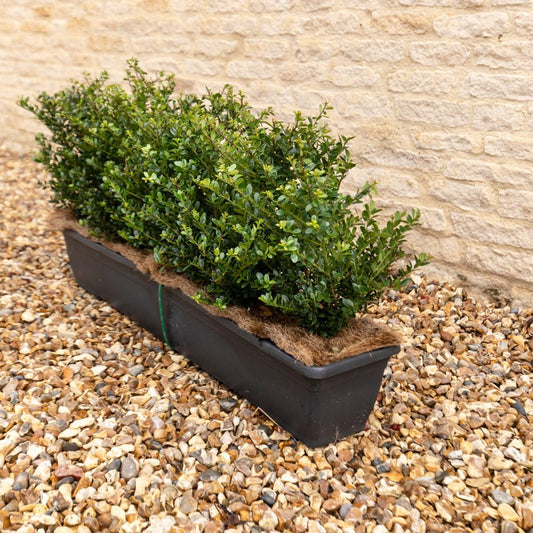
Japanese Holly Instant Hedge 35–40cm, 1m Trough – Evergreen
Vendor:Impact HedgingRegular price £95.00 GBP inc. VAT£79.17 GBP exc. VATRegular price£110.00 GBP£91.67 GBPSale price £95.00 GBP inc. VAT£79.17 GBP exc. VATON SALE

Why Choose Japanese Holly Hedging?
Japanese Holly (Ilex crenata) is an evergreen shrub valued for its fine foliage, compact growth and ability to form neat, structured hedges.
It is particularly popular with gardeners seeking an alternative to traditional Box (Buxus sempervirens), especially where box blight or box tree caterpillars have caused problems.
Japanese Holly offers several practical benefits:
- Evergreen foliage: Small, dark green leaves provide colour and structure throughout the year.
- Attractive Box alternative: Its compact appearance makes it suitable for replacing low Box hedges in appropriate growing conditions.
- Excellent for shaping: Responds well to pruning and can be maintained as a formal boundary.
- Slow to moderate growth: Usually requires less frequent trimming than faster growing hedging species.
- Versatile garden design: Suitable for pathways, courtyard gardens, decorative borders and geometric planting.
- Established instant hedging: Ready grown sections provide an immediate framework for a continuous hedge.
For gardens with suitable soil and drainage, Japanese Holly is an attractive choice for creating a tidy, elegant evergreen boundary.
Japanese Holly vs Box Hedging: Which Should You Choose?
Traditional Box has long been popular in British gardens for low hedges, formal borders and decorative topiary.
However, box blight and box tree caterpillars have led many homeowners to look for alternative evergreen plants.
Japanese Holly offers a similar appearance, with small, glossy leaves and dense growth that responds well to clipping.
Unlike traditional Box, Japanese Holly is not a host for box tree caterpillars and is not affected by the box blight pathogens that attack Buxus.
However, Japanese Holly has its own growing requirements. It prefers well drained, slightly acidic to neutral soil and can struggle in waterlogged ground or during prolonged hot, dry weather.
Japanese Holly is a good Box alternative when the planting conditions are suitable, but it is important to consider the soil and location before choosing a replacement.
Japanese Holly Instant Hedge 35 to 40cm, 1m Trough
Our Japanese Holly Instant Hedge 35 to 40cm is an established trough grown hedge supplied in convenient 1m sections.
Grown in Oxfordshire, this Ilex crenata 'Dark Green' variety has attractive, compact foliage that can be maintained as a low, formal hedge.
It is particularly suitable for:
- Front garden borders and entrances
- Pathways and garden edging
- Courtyard and patio gardens
- Formal and geometric planting schemes
- Low evergreen boundaries
- Decorative planting around landscaped areas
Unlike planting individual young shrubs, trough grown instant hedging provides a more established appearance from the beginning.
Each section measures 1m in length, making it straightforward to calculate how many units are required for your project.
For other planting styles and heights, explore our complete range of Trough Grown Instant Hedges.
Where Does Japanese Holly Grow Best?
Choosing the right planting location is particularly important for Japanese Holly.
Sunlight
Japanese Holly grows well in full sun or partial shade. In hotter or more exposed gardens, some protection from intense afternoon sunshine can help reduce moisture stress.
Soil Conditions
Japanese Holly prefers moist but well drained soil, ideally slightly acidic to neutral.
It is less suitable for highly alkaline or chalky soils, where poor nutrient availability can lead to yellowing foliage and weak growth.
Avoid planting in areas that remain waterlogged during winter.
If you are unsure about your soil, checking its pH and drainage before ordering can help you choose the most suitable hedging species.
Watering
Newly planted Japanese Holly requires regular watering while its roots establish.
The soil should remain adequately moist without becoming saturated. During prolonged dry weather, additional watering may be necessary even after establishment.
How to Plant Japanese Holly Instant Hedging
Our trough grown Japanese Holly provides an established section of hedging ready for planting.
For the best results:
- Prepare the planting area. Remove weeds and loosen the soil along the intended boundary.
- Check the drainage. Ensure water can drain freely from the planting area.
- Dig the planting trench. Make it wide enough to accommodate the root system without crowding.
- Position the hedge. Plant each section at the appropriate depth, keeping the top of the root system level with the surrounding soil.
- Backfill carefully. Fill around the roots and firm the soil gently.
- Water thoroughly. Water immediately after planting and continue regularly during the establishment period.
Spring and autumn are generally favourable planting times because temperatures are milder and natural rainfall helps support root development.
Avoid planting when the ground is frozen or waterlogged.
How to Care for Japanese Holly Hedges
Japanese Holly is relatively straightforward to maintain once established in suitable conditions.
Pruning and Shaping
Japanese Holly responds well to trimming and can be shaped into formal, straight edged hedges or softer decorative borders.
Light pruning during the growing season helps maintain a compact appearance. For many low hedges, one or two trims per year are sufficient.
Avoid heavy pruning during extreme heat, drought or freezing conditions.
Growth Rate
Japanese Holly typically grows around 10 to 20cm annually under favourable conditions.
Its relatively slow growth makes it particularly suitable for low borders and formal designs where a consistent height is important.
Feeding and Soil Care
Maintaining healthy soil conditions is important for Japanese Holly.
Apply a suitable mulch around the base to help retain moisture and reduce weed competition, keeping mulch away from the stems.
If foliage becomes yellow or growth weakens, check drainage, soil moisture and pH before applying fertiliser.
Why Buy Japanese Holly Hedges from Impact Hedging?
At Impact Hedging, we specialise in established, UK grown instant hedging designed to make creating attractive garden boundaries simpler.
Our Japanese Holly is grown in Oxfordshire and supplied in ready to plant 1m trough sections.
When you order from Impact Hedging, you benefit from:
- Established Japanese Holly hedging ready for planting
- Genuine Ilex crenata 'Dark Green' plants
- Convenient 1m sections for easy planning
- Free mainland UK delivery on qualifying orders over £350
- A 12 month plant guarantee, subject to its terms
- Support when selecting suitable instant hedging
Browse our Instant Hedges or contact our team if you need advice on choosing the right evergreen hedge for your garden.
Frequently asked questions
Is Japanese Holly a good alternative to Box hedging?
Are Japanese Holly hedges evergreen?
How quickly do Japanese Holly hedges grow?
Can Japanese Holly grow in shade?
What soil is best for Japanese Holly hedging?
How many Japanese Holly instant hedge sections do I need?